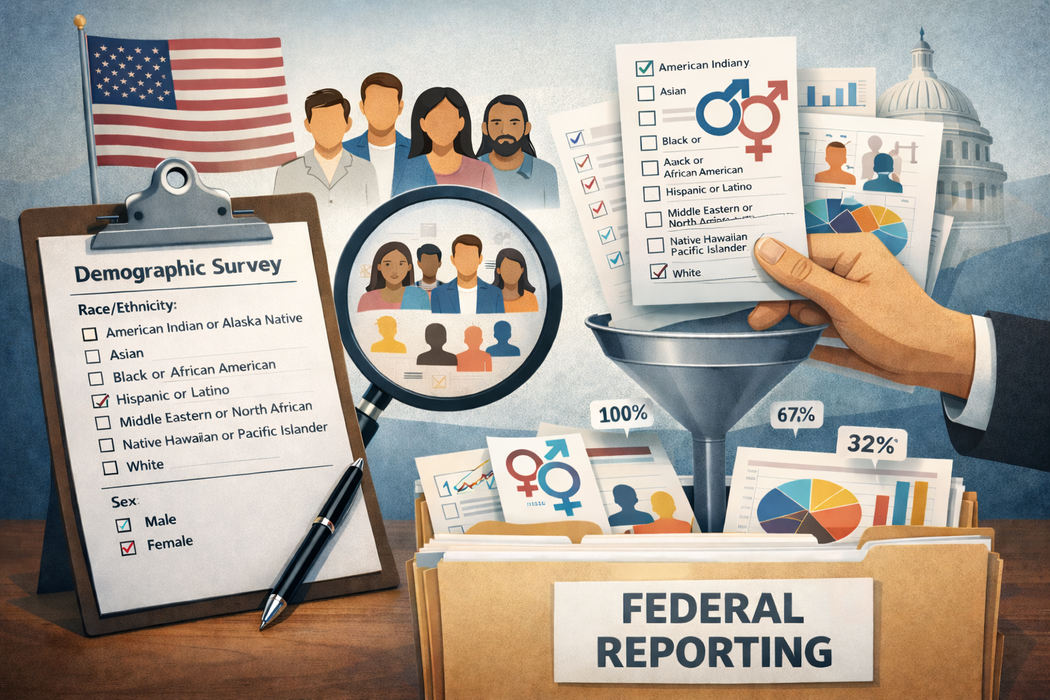
Demographic Data Collection
USDA regulations require that all institutions that receive federal support must collect participant race/ethnicity and sex data as a way of gauging how benefits and services are being delivered. As a recipient of federal funding, Extension is required to collect this information for each group educational activity we conduct. The information collected will only be used in aggregate form and does not affect a customers eligibility for services.The legal authority for collection of demographic data stems from Statistical Policy Directive 15 (2024 update), a federal policy from the U.S. Office of Management and Budget (OMB). This policy directive provides the standards for maintaining, collecting, and presenting race and ethnicity data for all federal information collection and reporting purposes. The categories in these standards are understood to be socio-political constructs and are not an attempt to define race and ethnicity biologically or genetically. In addition, Executive Order 14168 (2025) provides the standards for maintaining, collecting, and presenting sex data for all federal information collection and reporting purposes. Sex categories shall refer to an individual’s immutable biological classification as either male or female. Sex is not a synonym for and does not include the concept of gender identity.To comply with policy updates and executive orders, Extension data collection procedures have been updated and changes to demographic categories in Eventbrite and ERS have been made.
The sample data collection cards on the civil rights webpage have also been updated.
Collecting Data
Wherever possible, race and/or ethnicity and sex data should be collected from participants age 18 and older through self-report, where the respondents directly provide their own race and/or ethnicity and sex. Self-reporting shall be conducted in a manner that protects the privacy of individuals by utilizing demographic questions on registration forms, self-report paper and pencil surveys, or electronic surveys. Do not include the demographic questionnaire on a class sign-in sheet that is visible to all participants. In cases where self-report is not possible, data may be collected:- By proxy reporting, where a person knowledgeable of another's race and/or ethnicity responds on their behalf. (This is the preferred method for individuals under age 18.)
- By record matching, where existing records on an individual that contain their race and/or ethnicity are used to supply the information.
What Has Changed?
- Combined Question: A single question for race and ethnicity (instead of two separate ones) will be used to improve data quality and clarity for respondents.
- MENA Category: "Middle Eastern or North African" has been added as a new race category.
- Other Category: The “Other” race category has been eliminated.
Category Descriptions
The following categories shall be used to collecting race/ethnicity and sex data from program participants. Respondents shall be offered the option of selecting one or more race/ethnicity designations and an option that they prefer not to respond.Race/Ethnicity
- American Indian or Alaska Native: Individuals with origins in any of the original peoples of North, Central, and South America, including, for example, Navajo Nation, Blackfeet Tribe of the Blackfeet Indian Reservation of Montana, Native Village of Barrow Inupiat Traditional Government, Nome Eskimo Community, Aztec, and Maya.
- Asian: Individuals with origins in any of the original peoples of Central or East Asia, Southeast Asia, or South Asia, including, for example, Chinese, Asian Indian, Filipino, Vietnamese, Korean, and Japanese.
- Black or African American: Individuals with origins in any of the Black racial groups of Africa, including, for example, African American, Jamaican, Haitian, Nigerian, Ethiopian, and Somali.
- Hispanic or Latino: Includes individuals of Mexican, Puerto Rican, Salvadoran, Cuban, Dominican, Guatemalan, and other Central or South American or Spanish culture or origin.
- Middle Eastern or North African: Individuals with origins in any of the original peoples of the Middle East or North Africa, including, for example, Lebanese, Iranian, Egyptian, Syrian, Iraqi, and Israeli.
- Native Hawaiian or Pacific Islander: Individuals with origins in any of the original peoples of Hawaii, Guam, Samoa, or other Pacific Islands, including, for example, Native Hawaiian, Samoan, Chamorro, Tongan, Fijian, and Marshallese.
- White: Individuals with origins in any of the original peoples of Europe, including, for example, English, German, Irish, Italian, Polish, and Scottish.
- Prefer Not to Respond: Response to this question is optional, individuals may elect to not respond to the question.
Sex
- Female: A person belonging, at conception, to the sex that produces the large reproductive cell.
- Male: A person belonging, at conception, to the sex that produces the small reproductive cell.
- Prefer Not to Respond: Response to this question is optional, individuals may elect to not respond to the question.
Question Format
What is your race and/or ethnicity? Select all that apply.- American Indian or Alaska Native
- Asian
- Black or African American
- Hispanic or Latino
- Middle Eastern or North African
- Native Hawaiian or Pacific Islander
- White
- Prefer not to respond
- Female
- Male
- Prefer not to respond