
Extension strives to provide our stakeholders credible and actionable evidence about our programmatic efforts. We collect and report data and stories which demonstrate our relevance, quality, and impact.
Relevance
Being relevant means we are good stewards of the resources we are entrusted,. We use the resources for the purpose they are intended and on programs where there is an identified need. We demonstrate relevance by:
- Conducting needs assessments to identify the significant problems, issues, and/or needs of the local community
- Including stakeholders, community members, and advisory group members in the needs assessment process
- Implementing comprehensive educational programs to address the identified needs in areas where Extension has expertise and can make an impact
- Evaluating educational efforts to determine effectiveness and continued need
Quality
Being a quality program means customers are highly satisfied with Extension programs and services. Customer feedback is a commonly used measure of quality. We demonstrate quality customer service by:
- Determining the program qualities that are important to the program participants and our stakeholders (research based knowledge, convenient location, polite, responds in timely manner, etc.)
- Aligning the educational program to the program qualities important to the program participants and our stakeholders
- Surveying participants and stakeholders to determine satisfaction with the identified qualities
Impact
Having impact means that Extension has made a difference. The ultimate long term goal is social, economic, or environmental change. Before this can happen learning must occur; which in turn can lead to behavior change. Once you are able to show a change in behavior, then one can begin to show programming has made a difference. We demonstrate impact by:
- Showing demonstrated changes in learning (changes in knowledge and/or skills necessary for the desired behavior change to occur) as a result of participation in the Extension program
- Showing demonstrated changes in behavior (adopted practices necessary to attain the results) as a result of participation in the Extension program
- Showing demonstrated changes in social, economic or environmental conditions as a result of Extension efforts
Who is interested in our data?
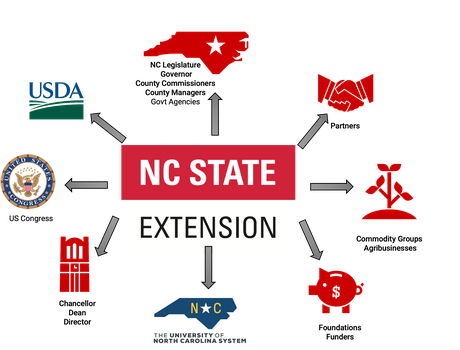
Federal Accountability Legislation
Smith Lever Act of 1914
The intent of the Smith Lever Act was to diffuse practical information on agriculture, home economics, and related subjects to people not attending college through demonstrations, publications, and education. A three-tiered system was created - federal USDA oversight, state-level leadership by land-grant universities, and local county-level extension agents. Smith Lever provides federal funding to land-grant colleges for outreach, which required matching funds from the states, ensuring a collaborative approach. Land-grant universities are required to submit an annual plan of work and an annual report of accomplishments.
National Agricultural Research, Extension and Teaching Policy Act of 1977
The National Agricultural Research, Extension and Teaching Policy Act established the USDA as the lead federal agency for agricultural research, extension, and teaching. It consolidated funding and set policies to improve U.S. agricultural competitiveness, sustainability, rural economic opportunity, and food safety. This Act is frequently reauthorized and amended through subsequent Farm Bills to align with current agricultural needs.The Act required the Department of Agriculture to submit an evaluation of economic and social consequences of the programs of the Extension Service to Congress.
Government Performance and Results Act of 1993
The Government Performance and Results Act of 1993 (GPRA) is a US law requiring federal agencies to manage program performance by setting goals, measuring results, and reporting progress. It mandates five-year strategic plans, annual performance plans, and performance reports to improve efficiency, accountability, and public confidence in government.
Agricultural Research Extension and Education Reauthorization Act of 1998
The Agricultural Research, Extension, and Education Reform Act of 1998 strengthened merit and peer review requirements for research, education, and extension grants funded by the USDA. It included the “Stakeholder Rule” where land-grant institutions are required to establish and implement a process for obtaining input from stakeholders concerning the use of federal capacity funds.The Act also required the USDA to prioritize research, extension, and education activities with national, multistate, or regional significance.
Resources
As a research-extensive land-grant university, North Carolina State University is dedicated to excellent teaching, the creation and application of knowledge, and engagement with public and private partners. By uniting our strength in science and technology with a commitment to excellence in a comprehensive range of disciplines, NC State promotes an integrated approach to problem solving that transforms lives and provides leadership for social, economic, and technological development across North Carolina and around the world.
The Agricultural Research, Education, and Extension Reform Act (AREERA) requires us to submit a plan of work, including yearly accomplishments and results, in order to receive federal funding and to help "tell the story" of how the land-grant university partners and NIFA are working together to advance agricultural research and extension across the nation.
NC State University is founded on integrity and expects members of the university community to demonstrate an unwavering commitment to the highest standards of excellence and ethical behavior. The decision making framework can help guide you to THINK and DO…The Right Thing!
NC State University’s Compliance and Integrity Program is designed to promote the university’s values and strives to integrate these values into its daily and long-term decisions and actions related to its educational, research, and business practices.
The HECA provides the higher education community with a centralized repository of information and resources for compliance with federal laws and regulations. The HECA Compliance Matrix lists key federal laws and regulations governing colleges and universities.